K-12 leadership is entering a period where the pace of change exceeds the pace of reporting. Enrollment shifts happen overnight. Staffing capacity changes weekly. Funding signals move faster than planning cycles. In this environment, volatility is not a temporary disruption; it is an operating reality.
This urgency extends beyond districts; state agencies are facing the same pressures and require the same level of real-time intelligence to guide statewide strategy and support local systems.
A recent K12Dive report highlighted this better than any data chart could. Several districts across Los Angeles, Chicago, and other major metros reported immediate enrollment drops tied to immigration enforcement activity. These shifts forced leaders to rethink class sizes, multilingual support, staffing assignments, transportation loads, and building-level budgets almost instantly.
The message is clear: Leaders cannot make decisions with information that arrives too late.
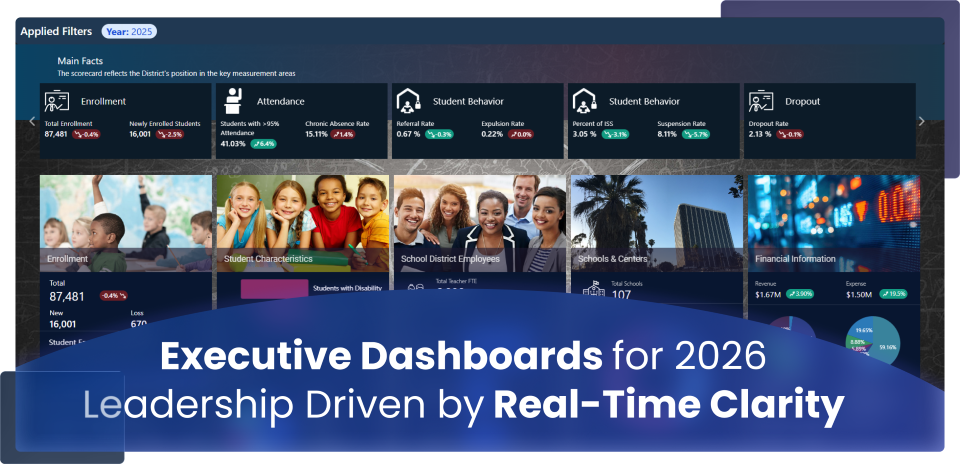
This is why by 2026, AI-powered executive dashboards for K-12 will become essential infrastructure, not another reporting tool, but the central command system for clarity, alignment, and intelligent decision making.
The Shift from Fragmented Tools to a Complete AI Powered K-12 Analytics
Every superintendent, CAO, CFO, and CIO knows the daily challenge:
Data lives everywhere in SIS, HR, finance, transportation, assessment systems, service tickets, spreadsheets, emails, and shared drives.
This fragmentation creates a leadership blind spot. One simple question becomes difficult to answer: Where do we stand today?
Fragmentation causes slow decisions, inconsistent narratives, and strategic plans that lose momentum because visibility is scattered.
A district leadership dashboard for decision making changes this reality by unifying:
- Real-time enrollment and subgroup trends
- Staffing pipelines and certification timelines
- Early warning indicators for attendance and achievement.
- Budget performance and cost-per-student insights
- Multilingual learner progress and resource allocation
- Whole-child and readiness indicators
- Operational workflows and service requests
This is no longer a technology upgrade. It is the foundation of modern leadership.
What Leading Districts Will Expect by 2026
1. Strategic Intelligence Through Dashboards Aligned to Vision
Leaders do not need more reports. They need dashboards that align to their strategic plan early literacy, equity commitments, graduation pathways, operational readiness, workforce development, and community priorities.
A modern K-12 leadership analytics platform makes a strategic plan measurable, dynamic, and always current.
2. Predictive Analytics Within the Best Executive Dashboard for K-12
Executives no longer ask, “What happened?” They ask, “What happens next?” Predictive dashboards powered by AI give leaders early signals the moment conditions begin to shift.
They show when enrollment starts to drift, when absenteeism patterns emerge, when staffing gaps may affect instructional quality, when spending trends move off plan, and when performance indicators begin to lose momentum. This is the kind of intelligence that lets leaders intervene early instead of reacting late.
3. Role-Based Visibility Across the Enterprise-Grade K-12 Dashboard Software
Superintendents, CAOs, CFOs, COOs, CIOs, HR directors, and principals should all operate from the same truth but each through the lens that supports their work. The goal is not to give leaders more dashboards.
The goal is to provide one unified source of truth with role-specific clarity, permissions, workflows, and insights. When every leader sees the right information at the right time, alignment becomes natural across the entire cabinet.
4. Integrated Data Storytelling for Boards and Communities
A modern AI-powered executive dashboard for K-12 should translate complex data into simple, transparent stories that leaders can use immediately.
It should produce board-ready visuals, clear equity snapshots, concise strategic plan briefs, community-facing updates, and accurate annual progress reports without extra work. When data communicates this clearly, leaders move from conversation to communication with zero friction.
5. A Real-Time Early Warning System for District Leaders
The K12Dive enrollment turbulence makes one point unmistakable: conditions can shift in hours, not weeks.
A real-time executive dashboard for education leaders must detect the earliest signs of movement—changes in enrollment, emerging attendance risk, resourcing mismatches, budget pressure, program strain, and subgroup disparities—long before they escalate.
Delayed visibility has become the biggest operational risk in K-12 leadership, and the districts that lead in 2026 will be the ones that eliminate it entirely.
Why Clarity Is Now a Leadership Requirement
Across leadership networks, research groups, and national organizations like CoSN, the same pattern keeps emerging: districts are making decisions with data that is too siloed, too slow, or too incomplete.
The CoSN Driving K-12 Innovation report identifies data interoperability and the lack of real-time visibility as core hurdles that limit strategic execution and contribute to delayed responses, instructional misalignment, financial inefficiencies, and operational instability.
A complete K-12 analytics dashboard solution changes that reality by giving leaders continuous clarity. It delivers a real-time understanding of what is shifting, what is improving, and what needs attention today—so decisions are grounded in truth, not in outdated reports.
The GPS Dashboard: A Model for 2026 Leadership Clarity
The GPS Dashboard demonstrates what next-generation executive visibility looks like for states and large districts.
It unifies academic, civic, well-being, and workforce readiness indicators into a leadership-ready view. Executives can instantly explore readiness across every student group and identify where pathways require deeper support.
With an AI-powered natural language assistant, leaders can ask: “Which student groups improved most in reading this year?” and get immediate, accurate answers without reports or delays.
This is what real decision readiness feels like.
Conclusion
Executive dashboards are not about charts. They are about leadership clarity.
Districts like Kentwood Public Schools have already shown the impact of moving from scattered reports to real-time visibility. They do not wait for updates or weekly summaries. They act the moment conditions change because the insight is already in front of them.
As 2026 approaches, the districts that lead will be the ones that embrace consistent, intelligent, real-time insight across their entire system.
Leadership becomes easier and far more effective when the picture is clear.
About Hexalytics
Hexalytics helps districts and state agencies build unified data and AI ecosystems that deliver real-time intelligence, stronger strategic planning, and leadership-ready insight.
Our platforms transform scattered information into clear action, giving every leader confidence and clarity to make faster, smarter decisions.
Equip your district with real-time, AI-powered decision intelligence by scheduling a strategic leadership review with our team. Contact us today
Key Takeaways
- Real-time insight is now essential for K-12 leadership.
- Rapid enrollment shifts demand faster, clearer decisions.
- Predictive signals show risks before they affect schools or budgets
- Unified dashboards eliminate fragmented systems and blind spots.
- Role-based clarity keeps every cabinet leader aligned and informed.
- AI turns complex data into simple answers leaders can act on instantly.
- Hexalytics delivers this leadership-ready visibility for districts and states.