The Shift from Manual to Machine
In June 2025, the State of Texas announced a record-breaking $481 million in Teacher Incentive Allotment (TIA) funds awarded to over 42,000 teachers. With the passage of House Bill 2 (HB 2), these numbers are set to skyrocket. Starting in the 2026–2027 school year, a new “Acknowledged” designation will open the door for the top 50% of Texas teachers to earn merit pay.
In this blog, we discuss how the growth of teacher incentive programs is reshaping performance management in K–12 districts, why manual processes are no longer sustainable at scale, and how HR data analytical solutions are helping districts connect workforce data to classroom outcomes. We reference Texas’ Teacher Incentive Allotment and TEA data as one example of how quickly these programs can grow.
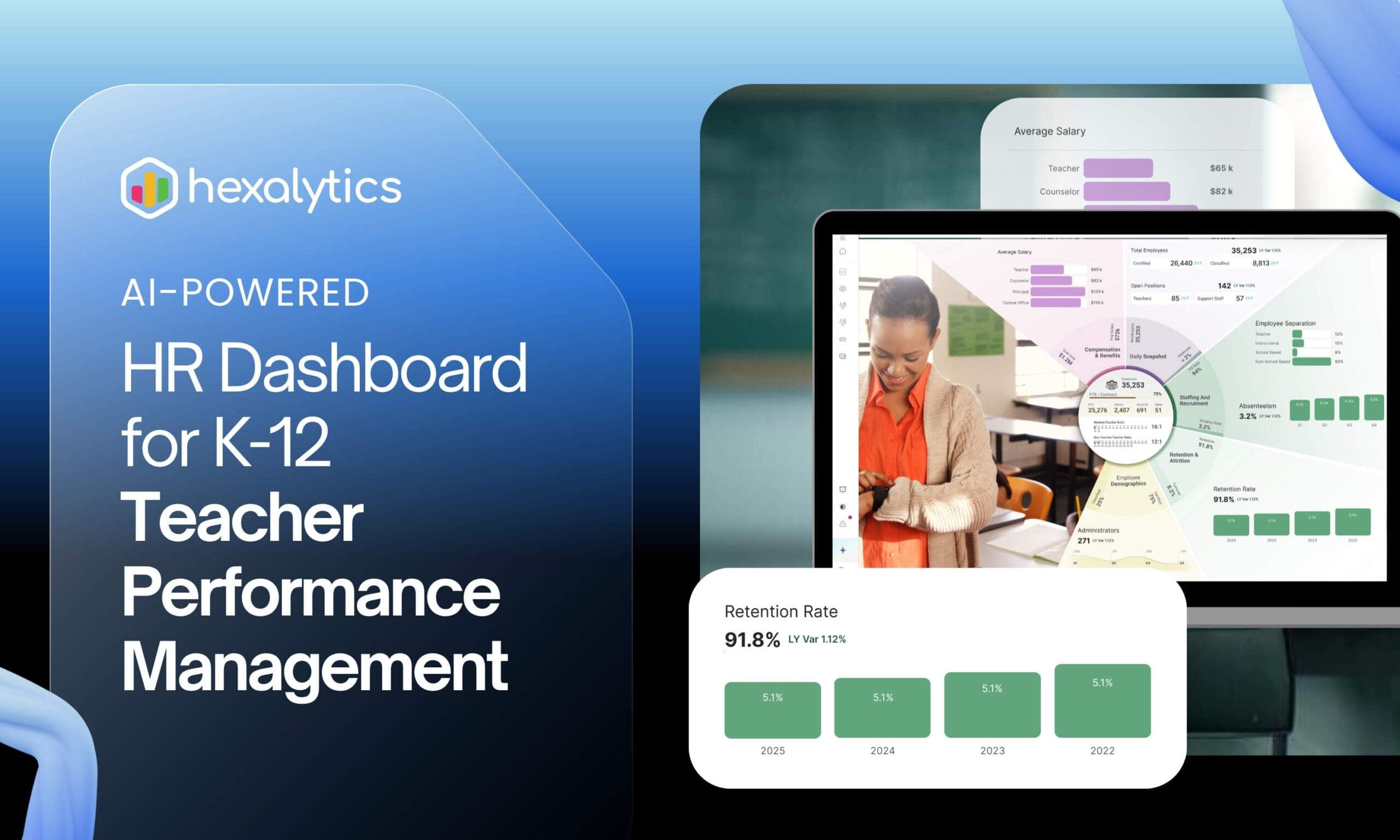
For the HR leaders, this expansion isn’t just an opportunity; it’s a data scalability crisis. As more teachers become eligible, manual student-teacher linkage and observation tracking become impossible. The solution? An AI-Powered HR Dashboard for K-12 Teacher Performance Management that bridges the gap between the TEA IODS and the classroom.
1. The Foundation: Why Ed-Fi Integration is Non-Negotiable
Successful teacher incentive programs depend on reliable, real-time data flowing through state reporting systems such as the TEA Individual Operational Data Store (IODS). Static CSV uploads introduce delays, inconsistencies, and what districts often experience as gradual “data drift.”
By 2026, the global AI market in K–12 education is expected to approach $8 billion, driven in part by the growing demand for unified, real-time data standards like Ed-Fi (Source: Grand View Research).
- Market Context: While TEA reports strong data validation outcomes among experienced districts, many high-needs districts continue to face challenges related to data accuracy and consistency during validation cycles (Source: TEA Data Validation Process).
- The AI Advantage: An AI-powered HR dashboard does more than move data between systems. By ingesting real-time Ed-Fi feeds, AI can continuously review instructional assignments and flag mismatches such as when a teacher’s SIS role code does not align with actual classroom responsibility before issues surface during the validation window managed by Texas Tech University (TTU).
2. Modern K–12 HR Analytics Platform Enables Predictive Teacher Incentive Planning
Under the newly enacted House Bill 2 (HB 2), the financial stakes for teacher performance have never been higher. A “Master” teacher can now generate up to $36,000 annually in additional funding for their district, a significant increase from previous caps (Source: TEA HB 2 Implementation Update). However, a major strategic problem remains: many districts operate in a “data rearview mirror,” discovering which teachers qualified only after the school year ends when it’s too late to provide support.
Yet many districts still operate with a lagging view of performance. Qualification outcomes are often confirmed only after the school year concludes, leaving little opportunity to support educators while it still matters.
An AI-powered HR analytics platform changes this dynamic. By applying predictive analytics, the dashboard connects T-TESS observation trends with student growth measures such as STAAR, Student Learning Objectives, or portfolio-based assessments. Historical patterns and real-time data are analyzed together, turning performance data into an early planning signal rather than a retrospective record.
- The predictive edge: When a teacher is trending at a 3.5 average in Domain 2 (Instruction) but requires a 3.7 to reach a “Recognized” designation, the system identifies this gap as early as November.
- Targeted support: This advance insight gives HR leaders and principals time to act. Targeted coaching and professional development can be introduced mid-year, helping high-potential educators reach performance thresholds by May—supporting both teacher retention and optimized incentive outcomes.
3. Roster Verification as a Retention Tool
Recent incentive program impact reports show that designated teachers are retained at rates nine percentage points higher than their non-designated peers. At a time when teacher retention is a national priority, transparency has become a critical factor in sustaining trust and engagement.
Modern HR platforms are responding by making roster verification a shared, visible process rather than a back-office task.
- The workflow: An automated, teacher-facing verification portal allows educators to review and confirm instructional assignments throughout the year. This reduces disputes, improves accuracy, and strengthens confidence in how performance data is applied.
- AI anomaly detection: The system continuously reviews roster patterns and flags inconsistencies—such as students with prolonged absences still linked to full instructional responsibility—helping districts maintain audit-ready submissions and data integrity.
4. Financial Transparency: Managing the 90/10 Split
State policy requires that 90 percent of incentive funds be allocated directly to teacher compensation at the designated teacher’s campus. While straightforward in statute, managing this distribution across multiple schools, roles, and funding scenarios introduces significant complexity for HR and payroll teams.
As incentive programs scale, even small miscalculations can create compliance risk or delay approvals.
AI-powered payroll forecasting addresses this challenge by continuously calculating projected payouts for each eligible educator based on the latest funding maps and program rules. District leaders gain a clear, forward-looking view of compensation distribution well before submission deadlines.
This level of visibility allows spending plans to be reviewed, adjusted, and validated in advance—ensuring alignment before the district submits its Letter of Intent and reducing last-minute reconciliation.
Conclusion
Performance-based compensation is becoming a defining feature of modern K–12 workforce strategy. As eligibility expands and funding grows, districts are being asked to manage instructional data, financial planning, and validation requirements at a level of scale traditional systems were never designed to support.
Districts that respond effectively are moving beyond fragmented tools and manual workflows. By unifying instructional assignments, performance signals, financial projections, and governance within an AI-powered HR dashboard, leadership teams gain continuous visibility and earlier decision points throughout the year.
What starts as a need for operational accuracy quickly evolves into a broader capability—one that improves transparency, supports educator growth, strengthens retention, and reduces compliance risk.
As states continue to elevate performance-driven models, the most prepared districts will be those that invest in intelligent, connected systems designed for scale.
The future of K–12 workforce management is predictive, transparent, and data-driven by design.
About Hexalytics
Hexalytics helps K–12 districts transform workforce and instructional data into decision-ready insight. Our AI-powered analytics platforms are designed to support complex, performance-driven environments by unifying HR, instructional, financial, and compliance data into a single, trusted view.
With deep experience across education data systems, governance, and AI, Hexalytics enables districts to move from reactive reporting to proactive workforce planning. Our solutions are built to scale, integrate seamlessly with existing systems, and provide continuous visibility throughout the academic year.
By combining modern data architecture with applied AI, Hexalytics supports transparency, accountability, and confident decision-making for district leadership teams.
Talk to Our Education Data Experts
Explore how an AI-powered HR dashboard can support performance management, workforce planning, and compliance readiness in your district.
Request a demo to see how Hexalytics helps districts connect data to outcomes—clearly, securely, and at scale.