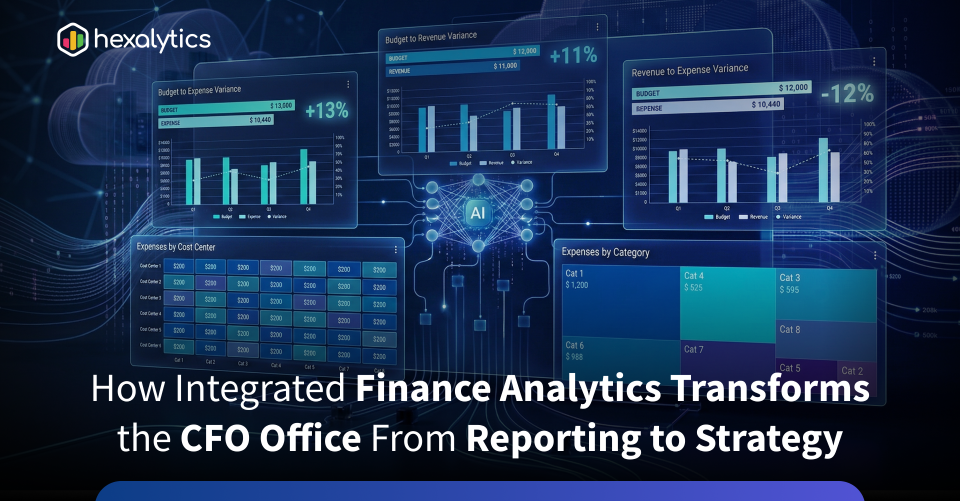
The average large enterprise runs three or more ERP systems. Its FP&A team spends more than 70% of its time collecting and reconciling data rather than analyzing it. And when the CEO needs a forward-looking answer, what happens to free cash flow if we delay the capital programme by one quarter the finance team needs days to model it.
According to McKinsey, companies that deploy advanced analytics in finance functions report decision cycle times that are two to three times faster than peers who rely on traditional reporting infrastructure. Yet most CFO offices are still operating on architectures designed for compliance and period-end accuracy, not operational speed. The gap between what finance can deliver and what the business needs is widening. Closing it is not a technological decision. It is a strategic one.
“CFOs are increasingly recognizing that their time is best spent on the challenging, unanswered questions on finance’s evolution.”
— Dennis Gannon, VP Research, Gartner Finance Practice (Gartner, November 2024)
Source: Gartner Newsroom — CFO Priorities 2025 → https://www.gartner.com/en/newsroom/press-releases/2024-11-20-gartner-survey-shows-cfos-rank-metrics-analytics-and-reporting-as-top-priorities-in-2025
This blog explores how that transformation works in practice and what it means for your organization.
The Structural Problem in Modern Finance
Most enterprise finance functions were not designed for the pace of modern capital allocation decisions. They were designed for auditability, period-end accuracy, and regulatory compliance. Those requirements remain. But the expectations placed on finance have grown beyond what legacy infrastructure can support.
Gartner’s 2024 CFO survey found that 82% of CFOs identify business partnering as a top priority, yet fewer than one in three rate their finance function as effective at delivering it. The bottleneck is structural, not motivational.
Three infrastructure problems explain most of the lag:
Multi-ERP environments and chart-of-accounts fragmentation
A company operating across three ERP platforms will routinely encounter inconsistent account mapping, intercompany elimination errors, and currency translation discrepancies that require manual resolution before any consolidated view can be produced. In a Deloitte survey, 67% of finance leaders cited data fragmentation across systems as the single largest obstacle to faster financial close and reporting.
Disconnected operational and financial data
Revenue forecasts sit in CRM. Headcount commitments sit in HRIS. Procurement obligations sit in a separate supply chain system. None of these feeds are automatically included in the financial model. The result is that FP&A teams spend the majority of each close cycle retrieving and formatting data work that generates no analytical value.
Manual Excel consolidation as a control risk
A consolidation workbook spanning fifteen contributing entities is not just slow to produce. It is a governance of liability. Version conflicts, formula errors, and overwritten cells are routine. According to a PwC finance transformation study, organizations that rely primarily on spreadsheet-based consolidation report close cycles that are 8.3 days longer than those using integrated platforms with measurably higher rates of restatement and audit adjustments.
The Financial Consequences of Slow Insight
Delayed financial data is not a reporting inconvenience. It is a capital allocation risk.
Consider this scenario, a consumer goods CFO is evaluating whether to accelerate a distribution centre investment before the end of the quarter to take advantage of a favorable vendor financing window. The decision depends on the current liquidity position, the 13-week cash forecast, and the projected impact on net debt covenants. That data exists across treasury, FP&A, and operations in systems that do not communicate with one another. Building a defensible model takes four days. The vendor financing window closes in three. The company proceeds without the analysis, accepts less favorable terms, and absorbs an incremental 40 basis points in financing cost on a $12 million commitment.
That 40 basis points are not visible on any dashboard. But compounded across a capital programme, it is material.
Forrester Research estimates that finance teams without integrated data environments lose 15 to 20 analyst days per quarter to manual reconciliation. That time could otherwise support scenario modelling, variance analysis, and strategic planning.
As Gartner’s Dennis Gannon noted in November 2024: “CFOs are increasingly recognizing that their time is best spent on the challenging, unanswered questions on finance’s evolution.”
Source: Gartner Newsroom — CFO Priorities 2025
Three Use Cases with Defensible Outcomes
Cash Flow Forecasting and Liquidity Management
Manual 13-week cash forecasting, assembled from bank feeds, AR aging reports, and AP schedules, carries an accuracy range of plus or minus 15 to 20% in most organizations. That margin of error is consequential when managing revolving credit facilities, navigating covenant thresholds, or optimizing short-term investment of surplus cash.
Automated cash forecasting, integrated across all banking relationships and entity ledgers, reduces forecast error materially and provides treasury teams with the lead time to act drawing on facilities, accelerating collections, or deferring discretionary spend before a gap occurs rather than after.
FP&A Scenario Planning Under Margin Pressure
When input cost inflation accelerated sharply in 2022 and 2023, most FP&A teams required two to three weeks to rebuild margin models with updated assumptions.
Organizations using integrated analytics can run financial analyses in hours instead of weeks. This allows finance leaders to enter pricing and procurement discussions with quantified financial insight.
McKinsey reports that companies with mature finance analytics capabilities achieve 25–40 percentage points higher forecast accuracy than the median, improving earnings guidance and capital allocation decisions.
Board Reporting and Investor Narrative Integrity
Board packs assembled from manual data pulls are typically 10 to 14 days old by the time they are distributed. For companies under earnings pressure or navigating a strategic transaction, that lag introduces both analytical risk and governance exposure.
Automated board reporting pulls data directly from live financial systems. It eliminates reporting lag and standardizes performance narratives across reporting periods. The result is more consistent and reliable investor communication.
CFO Outcomes: Framing the ROI Case
Gartner’s February 2025 survey found that 76% of CFOs now own or co-own enterprise data and analytics strategy a significant expansion of the traditional finance mandate. As Mallory Bulman, CFO Advisory Leader at Gartner, observed:
“Owning and anchoring strategic data and analytics to the overall business system will underscore CFOs’ ability to create a streamlined, measurable approach to boosting enterprise performance.”
Source: Gartner Newsroom — CFOs Taking on Broader Role Beyond Traditional Finance
The financial return on an investment in integrated finance analytics is measurable across three dimensions. First, close-cycle compression of 50-70% frees analyst capacity for higher-value work. Second, forecast accuracy improvements of 25 to 40 percentage points reduce the cost of planning errors and improve the reliability of external guidance. Third, compressed board reporting cycles, from five days to under two, reduce the governance risk associated with stale data in executive and investor communications.
The FTE savings from eliminating manual consolidation work typically offset a substantial portion of platform investment within the first twelve months making the financial case straightforward to construct for any CFO-level capital review.
A Capital Allocation Decision, Not an IT Project
The organisations building the strongest finance functions over the next five years will not necessarily be those that spend the most on technology. They will be those that treat financial data infrastructure as a strategic asset subject to the same investment discipline applied to any other capital allocation decision.
The cost of fragmented, lagging financial data is real. It appears in missed capital windows, mispriced financing, delayed responses to margin compression, and decisions made on numbers that were already outdated when the meeting started.
Integrated finance analytics does not eliminate uncertainty. It ensures that when decisions are made, they are grounded in the most current, complete, and reliable information the organization can produce.
For the CFO office, that is not a technology upgrade. It is a structural improvement in the quality of every decision the business makes.
About Hexalytics
Hexalytics is an analytical solutions company that helps finance and operations leaders build the data infrastructure behind better decisions. From financial consolidation and close automation to integrated FP&A platforms and board reporting tools, Hexalytics partners with CFO offices to reduce reporting latency, improve forecast accuracy, and connect financial insight to operational performance.
To explore what an integrated finance analytics environment would look like for your