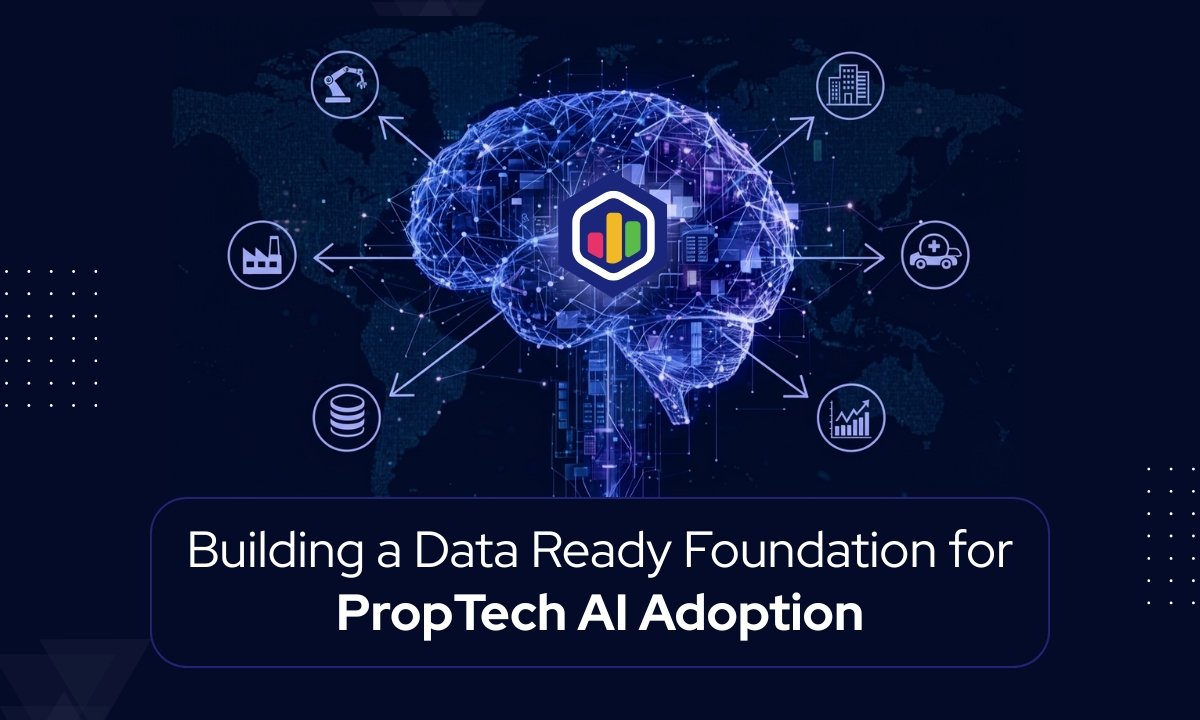
The $119 Billion Wake-Up Call Executive Leaders Cannot Ignore
Here is a number that should stop every real estate executive mid-meeting: the global PropTech market is projected to reach $119.9 billion by 2032, growing at a CAGR of 16.5% (Allied Market Research). Artificial intelligence, machine learning, and predictive analytics are no longer futuristic experiments; they are the new competitive infrastructure of commercial real estate, residential platforms, and property management ecosystems worldwide.
But here is the uncomfortable truth that rarely makes it into the boardroom conversation: the majority of real estate organizations are trying to fly a $10 million AI plane on a broken runway.
“More than 60% of commercial real estate firms are still reliant on legacy technology infrastructure and face difficulties adopting emerging technologies like generative AI.”
— Deloitte, 2024 Commercial Real Estate Outlook
Deloitte’s 2024 Commercial Real Estate Outlook Survey found that 61% of CRE firms still rely on legacy core technology infrastructure, while over 72% of global real estate owners and investors plan to commit hard dollars to AI-enabled solutions. That gap between AI ambition and data reality is where billions of potential value quietly evaporate.
This is where Hexalytics comes in, and this blog breaks down exactly why building a data-ready foundation is not an IT project. It is your most strategic business decision of 2026.
Before examining the data challenge, it is important to understand the scale of the
AI-in-real-estate transformation is already underway. Research and Markets reports that the AI in real estate market grew from $222.65 billion in 2024 to $303.06 billion in 2025 at a CAGR of 36.1% and is on track to reach $988.59 billion by 2029. These are not speculative trends — they are capital allocation decisions being made today.
1. AI-Powered Predictive Analytics Is Rewriting Valuations
Traditional property valuation models are being replaced by machine learning algorithms that process thousands of variables in real time. According to McKinsey Global Institute, AI could generate $110 billion to $180 billion or more in value for the real estate industry — with property valuation tools delivering estimates with as little as a 3% error margin. Firms deploying AI-driven automated valuation models (AVMs) are achieving accuracy improvements of 18–23% over conventional approaches.
2. Generative AI Is Transforming Tenant Experience and Leasing
Generative AI tools are now embedded across the tenant lifecycle. PwC’s Emerging Trends in Real Estate 2025 highlights that AI is primarily transforming administrative and technical tasks at scale, reducing leasing cycle times and improving tenant retention through AI-powered chatbots, natural language lease abstraction, and intelligent document review pipelines.
3. Smart Building IoT and Real-Time Data Integration
The IoT revolution is generating unprecedented operational data volumes. JLL’s 2025 Global Real Estate Outlook notes that AI companies nearly doubled their real estate footprint in two years and that data centre demand — underpinning smart building analytics — is growing at a 7.8% CAGR. Forward-thinking property managers using AI to consolidate IoT streams are cutting operational costs by 20–30%.
4. Regulatory Compliance and ESG Data Demands
ESG reporting requirements are intensifying across global real estate markets. Deloitte’s 2025 CRE Outlook found 76% of global survey respondents plan to undertake deep energy retrofits over the next 12–18 months, with 81% of respondents identifying data and technology as the area most likely to receive increased investment. AI systems purpose-built for ESG compliance in PropTech are becoming essential infrastructure, not optional add-ons.
5. The Rise of Real Estate Data Marketplaces
Property data is becoming a tradeable commodity. MarkNtel Advisors (March 2026) projects in the global PropTech market to grow from $32.5 billion in 2026 to $77.98 billion by 2032 (CAGR 15.7%), driven by AI, digital twins, and big-data analytics integration. Organizations able to connect external data streams to internal systems will hold a decisive competitive edge.
(Allied Market Research)
(Research & Markets)
(Deloitte, 2024)
(Deloitte Survey)
How Hexalytics Builds Your Data-Ready PropTech Foundation
Hexalytics is a specialized data intelligence partner purpose-built for the real estate and PropTech ecosystem. We engineer bespoke, AI-ready data foundations that give your technology investments the structural integrity they need to deliver measurable returns across four strategic pillars.
Pillar 1: Real Estate Data Unification and Cleansing
Most real estate organizations operate with data fragmented across property management software, CRMs, financial systems, and market data feeds. Deloitte’s Generative AI in Real Estate report explicitly states that ‘generative AI applications are only as good as the data that feed them’ a principle that holds for every class of real estate AI. Hexalytics deploys advanced ETL pipelines and master data management (MDM) frameworks to resolve entity duplication, standardize property identifiers, and create a single source of truth. Our data quality scores consistently exceed accuracy thresholds the standard that enterprise AI demands.
Pillar 2: AI-Ready Data Architecture and Infrastructure
Building AI solutions on legacy database infrastructure is like installing solar panels on a condemned building. PwC research underscores that the AI-related GDP CAGR through 2030 is 18.6%, with real estate firms needing cloud-native infrastructure to capture that value. Hexalytics architects’ data lakes and Lakehouse environments on Databricks, Snowflake, and Azure Synapse — optimized for the high-volume, high-velocity data profiles of PropTech applications including real-time IoT streaming, structured financial data, and unstructured document processing.
Pillar 3: Predictive Analytics and AI Model Enablement
Data architecture is the foundation — but Hexalytics also accelerates the AI model development lifecycle itself. McKinsey’s analysis shows that organizations with mature data foundations deploy AI initiatives significantly faster and at lower cost than those starting from scratch. Our data science teams specialize in feature engineering for real estate use cases — building occupancy forecasting models, automated lease abstraction pipelines, tenant churn prediction engines, and portfolio risk scoring systems with model-ready datasets.
Pillar 4: Governance, Compliance, and ESG Data Frameworks
Data governance in real estate is increasingly regulated. Deloitte’s 2025 CRE Outlook reveals that 76% of global real estate respondents plan deep energy retrofits requiring auditable sustainability data within 12–18 months. Hexalytics implements enterprise-grade governance frameworks ensuring lineage tracking, access controls, audit trails, and compliance with cross-jurisdiction privacy regulations. For ESG reporting, we build automated pipelines structured for direct output into GRI, SASB, and TCFD frameworks — making your ESG story data-driven, defensible, and investor-ready.
“Over 72% of global real estate owners and investors are already committing, or plan to commit, hard dollars to AI-enabled solutions — yet 61% still operate on legacy technology.”
— Deloitte 2024 Commercial Real Estate Outlook Survey
The Competitive Divide Is Opening — Which Side Will You Be On?
The PropTech AI revolution is not slowing down to wait for organizations to sort out their data infrastructure. The Business Research Company projects the AI in real estate market will hit $1.3 trillion by 2030 at a 33.9% CAGR. The firms that dominate real estate over the next five years are making their foundational data investments right now.
The question for every CIO, CDO, and real estate technology leader reading this is not whether your organization needs an AI strategy. The question is whether your data infrastructure is capable of making that AI strategy real.
Fragmented data pipelines, inconsistent property records, and siloed operational systems will not just slow your AI adoption — they will actively corrupt it. A machine learning model trained on poor-quality data does not produce mediocre insights. It produces confidently wrong ones, at scale.
The organizations that invest in data readiness today are not spending money — they are buying speed, accuracy, and competitive separation that will compound over years. Deloitte’s latest outlook confirms that 81% of real estate professionals now identify data and technology as their primary spending focus. The market has spoken. Hexalytics exists to make that investment efficient, expert-led, and results-oriented.
Your AI ambitions deserve a data foundation that can hold them. Let us build it together.
About Hexalytics
Hexalytics is a data intelligence and analytics leader helping organizations unlock the full value of their data. We architect AI-ready data foundations, engineer scalable pipelines, and deliver predictive insights that move businesses forward. With a global client base spanning multiple industries and geographies, Hexalytics sits at the intersection of data engineering, artificial intelligence, and business strategy — turning information into impact, at scale.