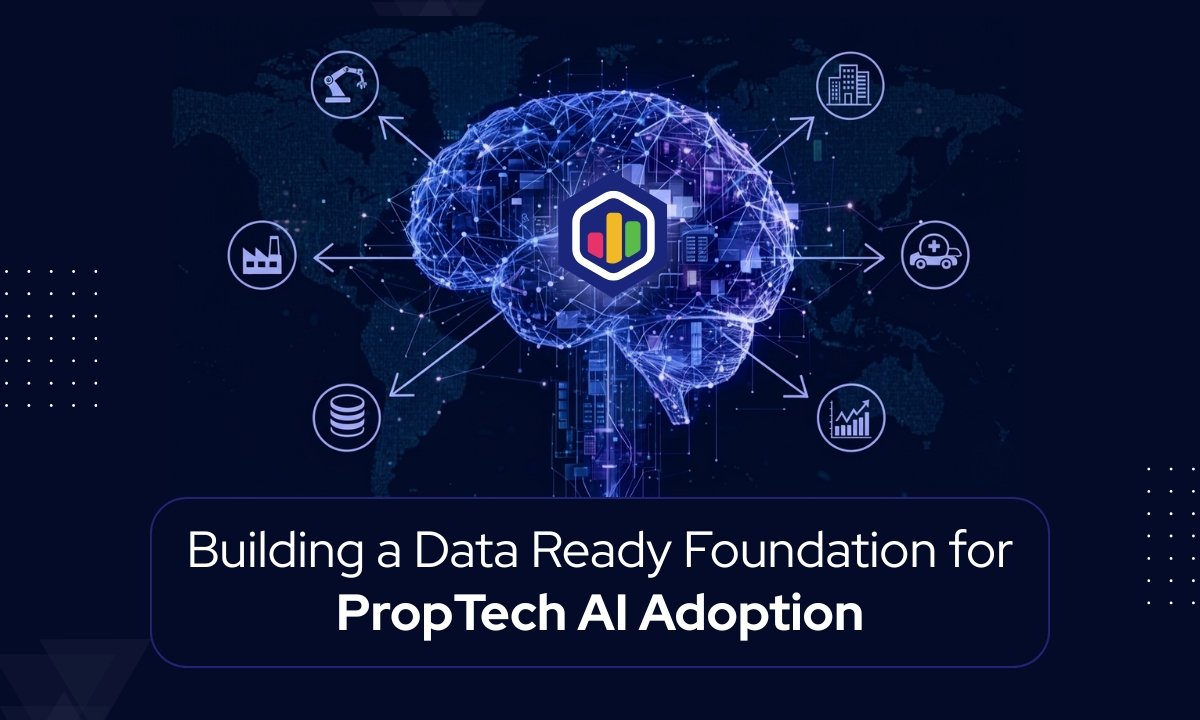
“According to Deloitte, 67% of real estate executives cite data fragmentation as one of their top three operational challenges. Yet most organizations continue to manage billion-dollar portfolios on disconnected systems. ”
Real estate is, at its core, a data business. Every lease agreement, maintenance request, occupancy rate, and capital expenditure tells a story. Together, these data points determine whether a portfolio thrives or underperforms. Yet for most real estate organizations, these stories are told in isolation, and the cost is significant.
The problem is not a lack of data. It is a lack of connected data. Across property management platforms, leasing systems, ERP tools, tenant portals, and finance dashboards, critical information remains locked in silos. The result is a fragmented view of performance that makes sound, real-time decision-making nearly impossible.
The Silo Problem in Real Estate Organizations
Modern real estate organizations generate more data than ever before. A mid-size commercial portfolio can involve dozens of systems: building management software, lease administration tools, investor reporting platforms, tenant experience apps, and IoT sensors on the floor.
Each of these systems captures valuable information. But when these systems do not talk to each other, leadership is left stitching together spreadsheets and static reports. Finance does not see what operations see. Asset managers lack real-time visibility in tenant behavior. Leasing teams cannot connect occupancy trends to capital planning.
This is the fundamental challenge of data silos in real estate: not that the data does not exist, but that it cannot flow where it is needed most.
What Disconnected Data Actually Costs You
The business impact of data silos is not theoretical. It shows delayed decisions, missed opportunities, and revenue that quietly walks out the door.
Lost ROI
When asset managers cannot access integrated performance data, capital allocation decisions default to intuition rather than insight. Properties that appear stable on surface metrics may be quietly underperforming when maintenance costs, vacancy cycles, and lease renewal risk are viewed together. Real estate ROI optimization begins with visibility, and visibility requires integration.
Delayed Decision-Making
In a market defined by rising interest rates and shifting demand patterns, speed matters. Organizations that rely on monthly reports from disconnected systems are always deciding in the past. By the time leadership reviews aggregated portfolio analytics, the window for optimal action has often closed.
Inefficient Asset Utilization
Underutilized space is a silent drain on portfolio performance. Without a unified view of occupancy, usage patterns, and demand signals, organizations routinely carry costs they do not need to and miss revenue opportunities hiding in plain sight.
Poor Tenant Experience and Revenue Leakage
Tenant retention is one of the most direct drivers of real estate ROI. When maintenance, leasing, and tenant experience data operate in separate systems, service quality suffers. Renewal risk goes undetected. Revenue leakage occurs not through single large events, but through a steady accumulation of small inefficiencies that are invisible until they become expensive.
The Case for Unified Data Intelligence
“Unified data intelligence is not a technology project. It is a strategic capability that allows real estate leaders to see their entire portfolio through a single, coherent lens. ”
Rather than maintaining separate systems that each tell part of the story, unified data platforms consolidate property, financial, operational, and tenant data into a single integrated environment. Dashboards have become dynamic. Reporting becomes real-time. Decisions become genuinely data driven.
This is not about replacing existing systems. It is about connecting them intelligently so that data flows across the organization and surfaces as actionable intelligence at the right level of the business.
Real-World Use Cases: Where Unified Data Drives Results
Breaking down data silos is not an abstract aspiration. These are the specific business scenarios where integrated real estate data analytics creates a measurable impact.
Use Case 1: Lease Renewal Risk Detection
A commercial landlord managing a large office portfolio struggled with reactive lease renewals. Tenant communication data, payment history, and space utilization of metrics lived in three separate systems. By the time the leasing team identified a renewal risk, the negotiation window had already narrowed.
After integrating these data streams into a unified dashboard, the team could see early signals of tenant disengagement, declining space usage, and payment delays in a single view. Renewal conversations started 90 days earlier. Vacancy risk dropped measurably across the portfolio.
Use Case 2: Capital Expenditure Prioritization
A real estate investment firm was allocating capital across 40 assets based on annual maintenance reports and historical performance. Without integration between facilities data, financial performance, and market benchmarks, the prioritization process took weeks and often relied on management intuition.
With property portfolio analytics connecting these sources, the firm built a dynamic capital prioritization model. Assets were ranked in real time by risk-adjusted return potential. Capital deployment decisions that previously took three weeks were reduced to a matter of days, with greater confidence in the outcome.
Use Case 3: Portfolio-Wide Occupancy Optimization
A diversified real estate operator was unable to compare occupancy performance across asset classes because each business unit used a different reporting format. The result was inconsistent with benchmarks and no ability to identify underperforming properties at the portfolio level.
A unified data layer with standardized occupancy metrics across residential, commercial, and industrial assets. Leadership could, for the first time, view portfolio performance against internal benchmarks and market comparables on a single screen. Underperforming assets were identified and actioned within one reporting cycle.
Use Case 4: Predictive Maintenance and Cost Control
Unplanned maintenance is one of the most disruptive and costly events in real estate operations. A property management group was managing maintenance reactively, with work orders, vendor contracts, and asset condition data stored in separate systems.
By integrating IoT sensor data, maintenance history, and vendor performance metrics through a unified platform, the team built a predictive maintenance model. High-risk equipment was flagged before failure. Emergency repair costs fell significantly, and tenant satisfaction scores improved as a direct result.
Use Case 5: Investor Reporting Automation
Institutional investors increasingly expect real-time, granular portfolio reporting. A real estate asset manager was spending more than 40 hours per month consolidating data from disparate systems to produce investor packs.
With data integration in place, investor dashboards were automated. Property performance, financial metrics, ESG data, and market comparables were pulled from a single source of truth. Reporting time was reduced by over 70 percent, and investor confidence in data accuracy improved.
Breaking Silos: What Becomes Possible
Organizations that invest in data integration consistently report measurable improvements across key performance dimensions.
- Real-time portfolio visibility: Integrated dashboards give asset managers a live view of performance across every property, market, and asset class, without waiting for consolidated reports.
- Predictive insights: When operational, financial, and market data combine, AI models can identify patterns that predict lease renewals, maintenance needs, and demand shifts before they are visible to analysts.
- Better capital allocation: With integrated property portfolio analytics, capital decisions become sharper. Leaders identify underperforming assets sooner and prioritize high-yield investments with greater confidence.
- Improved operational efficiency: When teams work from the same data environment, redundant reporting is eliminated, and cross-functional coordination improves meaningfully.
Conclusion: The Leadership Imperative
Data silos are not an IT problem. They are a leadership problem. They represent a strategic gap between the information an organization generates and the intelligence it can act on.
For CXOs and asset managers navigating an increasingly complex real estate landscape, the question is no longer whether to prioritize data integration. The question is how quickly to move and how boldly to commit.
The real estate organizations that will outperform in the next decade are building the data foundations today. They are replacing fragmented reports with real-time dashboards. They are replacing reactive decisions with predictive intelligence. They are replacing data chaos with unified portfolio clarity.
The competitive advantage in real estate is shifting from who owns the best assets to who makes the best decisions. And the best decisions always start with the best data.
About Hexalytics
Hexalytics is a data intelligence and analytics leader helping organizations unlock the full value of their data. We architect AI-ready data foundations, engineer scalable pipelines, and deliver predictive insights that move businesses forward. With a global client base spanning multiple industries and geographies, Hexalytics sits at the intersection of data engineering, artificial intelligence, and business strategy — turning information into impact, at scale.