Why Predictive Analytics is Replacing Static KPIs in P-20 Education
P-20 Education
P-20 Education
In the traditional P-20 landscape spanning from preschool through graduate school, educational leadership has historically relied on “Rearview Mirror” metrics. These Static Key Performance Indicators (KPIs), such as end-of-year standardized test scores, annual graduation rates, and fall enrollment figures, provide a post-mortem of what happened after the window for intervention has closed.
Today, a fundamental shift is occurring across the academic sector. Forward-thinking institutions are moving away from reactive reporting in favor of Predictive Analytics and AI. The conversation is shifting from retrospective questions like “How many students failed last semester?” to proactive inquiries: “Which students are likely to struggle three weeks from now?”
From Insight to Actionable Solutions
The transition to predictive analytics requires more than just a change in mindset; it requires an integrated data ecosystem. Modern solutions are designed to bridge the gap between “what happened” and “what will happen.”
How Predictive Analytics is Transforming P-20 Outcomes
By leveraging Machine Learning (ML) and Generative AI, educational systems can now process vast streams of “behavioral trace data” ranging from Learning Management System (LMS) engagement patterns to mid-term student sentiment.
1. Advanced Early Warning Systems (EWS)
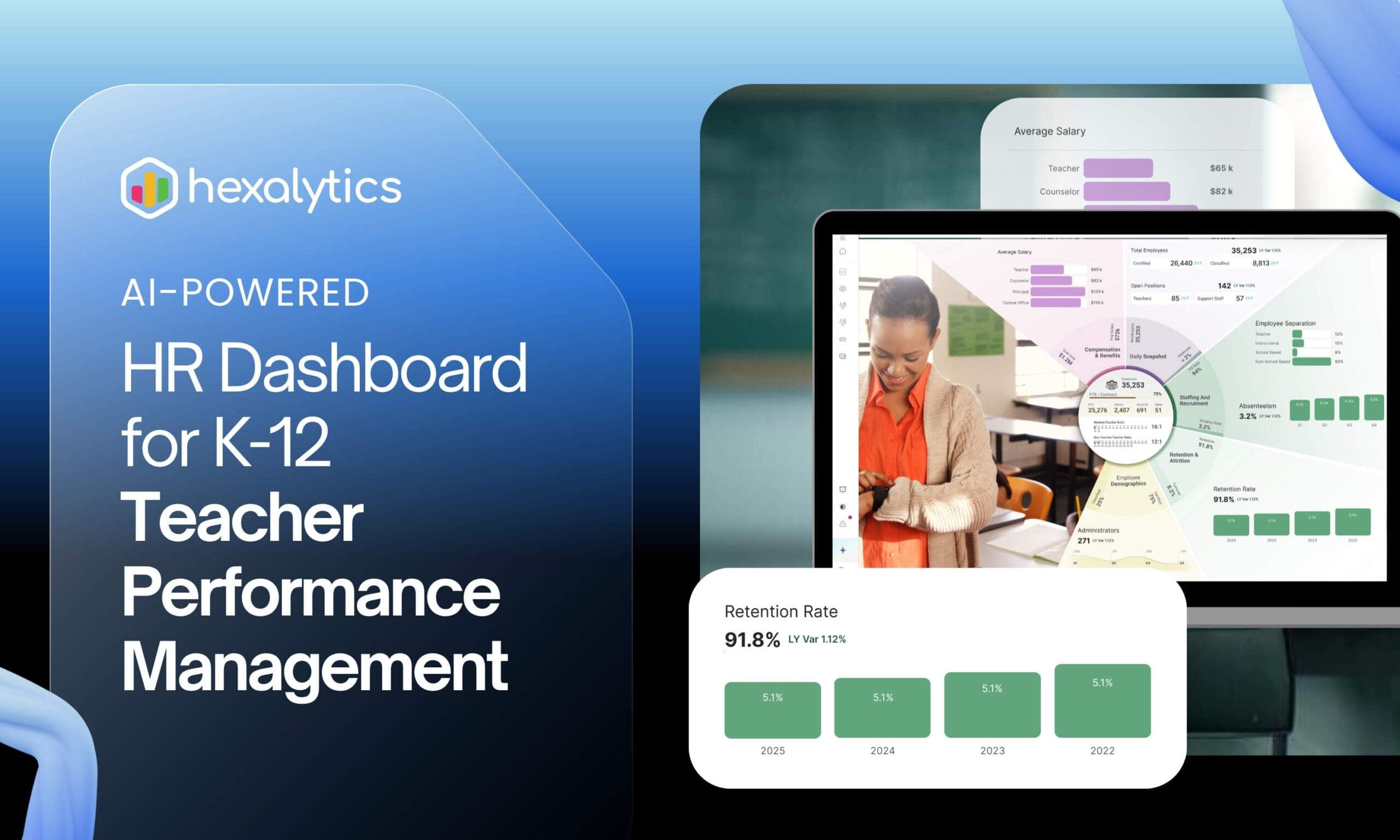
Predictive models identify at-risk markers with startling accuracy long before a failing grade is ever recorded. Solutions like Hexalytics K12 360 integrate academic, attendance, and behavioral data into a “Whole Child” view, allowing leaders to see disengagement in its infancy.
Research Datapoint: Recent studies indicate that advanced ML algorithms (such as XGBoost) are significantly more effective at identifying at-risk students than traditional metrics like high school GPA alone (Source: University of Oregon / AIR).
For administrators, predictive analytics replaces guesswork in fiscal planning. The Hexalytics Enrollment Dashboard uses historical trends and community shifts to forecast student populations with high confidence, allowing for optimized faculty hiring.
Institutional Success: By analyzing over 800 risk factors daily, Georgia State University utilized predictive tools to trigger over 90,000 targeted interventions annually, contributing to an 8-percentage-point increase in graduation rates (Source: Mapademics / GSU Study).
3. Closing the Digital Equity Gap
Standard reporting often obscures the “why” behind underperformance. The Digital Access Dashboard provides real-time visibility into student connectivity and device access, turning equity into a measurable, solvable metric rather than a vague goal.
Outcome: Schools implementing AI-powered personalized tracking have observed a 12% increase in student attendance through targeted digital support (Source: Codegnan / AI Education Trends 2026).
Moving from Prediction to Prescription
As we move into 2026, the industry is entering the era of Prescriptive Analytics. This is where systems don’t just identify a hurdle they suggest a specific, evidence-based intervention.
Through the Hexalytics MAX (Modern Analytics Experience) framework, institutions can automate the data pipeline, ensuring that the “Semantic Layer” of their data provides natural-language answers to complex leadership questions. AI identifies the patterns, but educators provide the empathy and contextual judgment required for effective support. Recent research emphasizes that while AI can predict performance with 70-80% accuracy, human oversight is essential to ensure ethical application (Source: World Journal of Advanced Research and Reviews).
Conclusion:
The evolution from static KPIs to predictive analytics represents more than a technological upgrade; it is a shift toward a culture of proactive student care. By moving beyond “Rearview Mirror” metrics, P-20 institutions can finally close the gap between identifying a challenge and delivering a solution. As we move into 2026, the goal is no longer just to report on the past, but to actively shape the future of every learner through data-driven precision.
About Hexalytics:
Hexalytics is a premier AI and data leader across the K-12 and P-20 landscape. With over 15 years of deep industry experience, we serve as a trusted partner to school districts, state agencies, and higher education institutions. We specialize in navigating the complexities of educational data, helping leaders bridge the gap between fragmented information and strategic action. By combining institutional wisdom with cutting-edge AI expertise, Hexalytics empowers educational organizations to move from legacy systems to modern, intelligent ecosystems that prioritize student success and operational clarity.
1. How does predictive analytics differ from the dashboards we already use?
Traditional dashboards typically showDescriptive Analytics—what happened in the past. Predictive analytics uses Machine Learning to forecast what is likely to happen, allowing for earlier intervention before a student fails.
2. Is predictive analytics reliable enough to base student interventions on?
While no model is 100% certain, advanced ML algorithms are significantly more accurate at identifying at-risk students than traditional markers like GPA. We advocate for a “human-in-the-loop” approach where data flags the risk, but educators provide the final professional judgment.
3. Does implementing AI-driven analytics require an overhaul of our current systems?
No. Modern solutions are designed to be technology agnostic, sitting on top of your existing Student Information Systems (SIS) and Learning Management Systems (LMS) to unify and amplify the data you already have.
4. how does this support institutional goals beyond student grades?
Beyond academics, predictive tools provide foresight into enrollment trends, resource allocation, and digital equity gaps, helping administrators make data-backed decisions for long-term sustainability.
5. How do these tools address student data privacy and FERPA compliance?
Privacy is foundational. Modern platforms use secure, role-based access controls and encrypted data pipelines to ensure that all processingremains fully compliant with FERPA and local privacy regulations.
Subscribe to our newsletter
Unlock the full potential of your data with Hexalytics — modern analytics, AI-powered insight, and custom dashboards tailored to drive smarter decisions. Let us help you turn raw data into business value.